On 16 July 2026, Uber agreed to pay €41.50 a share for Delivery Hero, a deal valuing the Berlin company at USD 14.8 billion and taking Uber's combined platform to 99 markets. The headlines counted the markets: talabat across the Gulf, HungerStation in Saudi Arabia, Baemin (Baedal Minjok) in South Korea, Glovo across Europe and Africa, PedidosYa in Latin America. Underneath those brands are roughly fifty different ways of moving money, none of them designed to talk to each other, and that is the part of this deal that doesn't show up in the €41.50.
Consider what happens when a customer in Riyadh pays for a HungerStation order and a customer in Bogotá pays for a PedidosYa order in the same second. Both taps feel identical. Behind them sit different card schemes, different local bank rails, different regulators, different settlement currencies, and different reconciliation cycles. Delivery Hero grew by acquisition, and each acquisition brought its own payments stack. The order flow was unified long before the money flow was. That gap, between a single customer experience and dozens of underlying transaction processing systems, is the part of this deal that doesn't show up in the €41.50.
Delivery Hero's acquired operations generated roughly USD 42 billion in gross bookings last year across the 50 markets Uber is keeping. Every one of those bookings is a chain of events: authorise the card or wallet, route it to the right acquirer, clear it, settle it in local currency, then reconcile the platform's cut against the courier's payout and the restaurant's share. Run that chain fifty times, in fifty regulatory environments, and the operational cost isn't the order volume. It's that the merged company inherits fifty reconciliation problems it now has to close every single day.
Why transaction processing decides how fast this integration goes
A payment switch sits between the app and the money. It takes each transaction and directs it to the correct processor, network, or destination based on rules, then handles authorisation, settlement, and the accounting that follows. When two companies merge, the tempting move is to leave each region's switch alone and just consolidate the reporting on top. It works for a quarter. Then a scheme changes its rules in one market, a settlement window shifts in another, and finance is chasing breaks across systems that log the same transaction three incompatible ways.
The alternative is to consolidate the processing itself: one engine handling card transactions, bank transfers, wallet payments, and cross-border payments through a single integration, with multi-channel routing deciding the path per transaction and real-time settlement configured per market. Multi-currency settlement is where a deal like this lives or dies. talabat settles in Saudi riyals and dirhams, Baemin in won, PedidosYa across a dozen Latin American currencies. Consolidating that under one transaction processing layer is the difference between an integration measured in quarters and one measured in years.
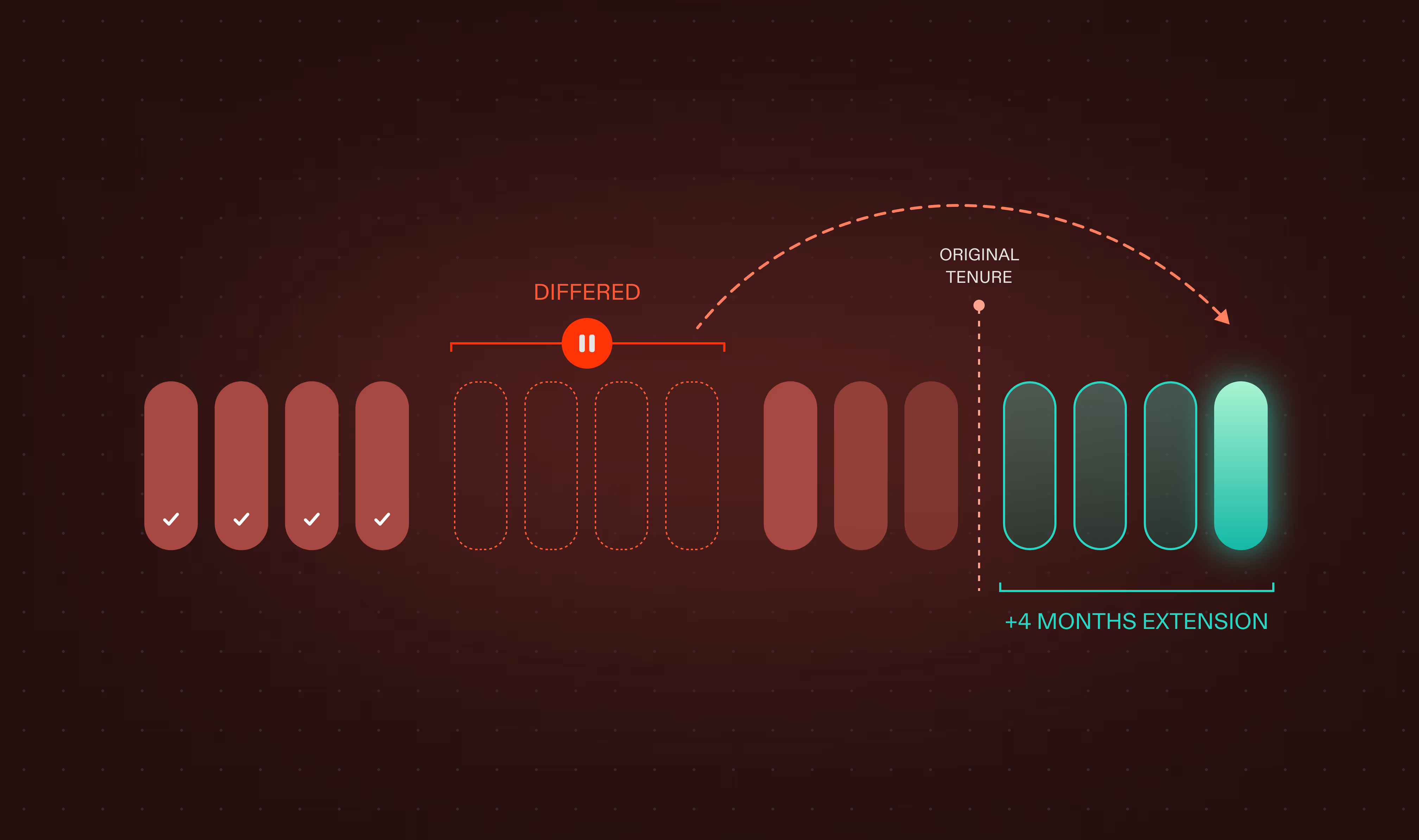
Uber has said it expects high-single-digit EPS accretion by year three. Year three is not an arbitrary target. It's roughly how long payments integration takes when you do it properly, and considerably longer when you don't. The synergies Uber is underwriting assume the money flow eventually looks as unified as the order flow. Until the switches, settlement, and reconciliation actually merge, the combined company is running two platforms wearing one logo.
There's also the piece the deal structure quietly acknowledges. Delivery Hero is separately selling operations in 14 markets to SSW Partners for about USD 1.6 billion, several of them places where Uber Eats already runs. Carving those out cleanly means untangling shared payment infrastructure: which settlement accounts, which acquirer contracts, which reconciliation ledgers belong to which buyer. That's only tractable if the underlying processing is modular in the first place. When it's a decade of local integrations fused together, separation is its own multi-year project.
The customer ordering shawarma in Jeddah or empanadas in Buenos Aires will notice nothing. The tap stays instant, the receipt arrives, the courier is dispatched. The work Uber has actually bought is everything that happens after the tap, across ninety-nine markets that each learned to move money their own way. Whether this deal earns its price depends less on the food and more on the infrastructure nobody photographs.